CBSE 2026 Exam Datesheet Under Fire: No Breathing Space Between Major Subjects?
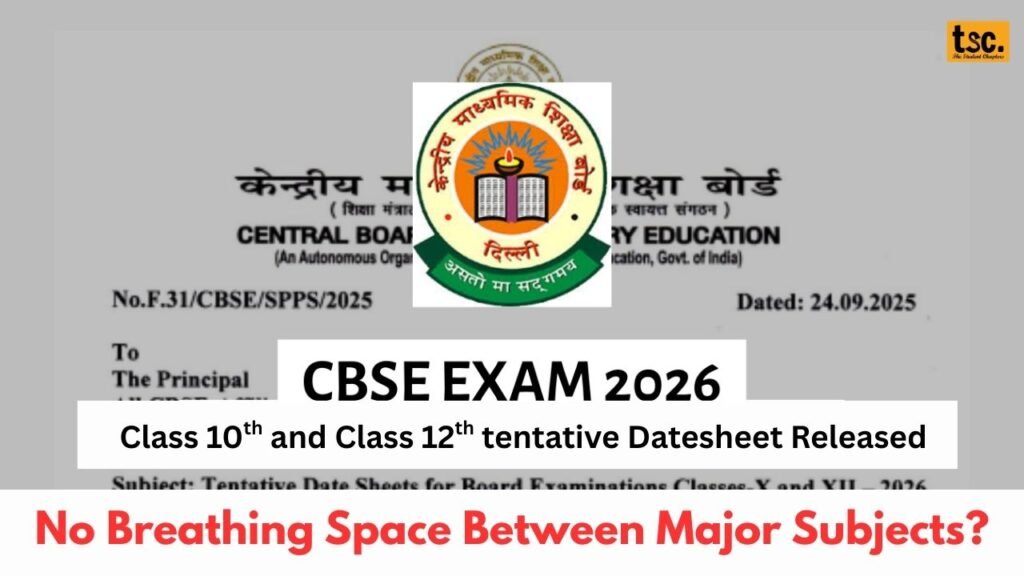
Finally, the much-awaited datesheet is released for Class 10 and Class 12 board examinations! The Central Board of Secondary Education (CBSE) again shook the souls from beneath, as students are tense over no tight scheduling of certain critical subjects in the CBSE 2026 Exam Datesheet.
Whether parents, teachers or students, all the debating on many social media platforms as the timetable appears structured and spans over seven weeks. While you see the datesheet at your first glance, you find that this systematic arrangement seems fair, but closer examination reveals issues that could put additional pressure on students.
Exactly, that is the reason everybody is stressing over! Meanwhile, there are many high-stakes papers placed back-to-back. This leads to minimal time for the students for revision. At last, this can affect the student’s performance!
Class 10 Concerns over CBSE 2026 Exam Datesheet
If I talk about the date sheet of class 10, then the higher authorities scheduled the science exam on February 25, 2026, which comes just a day after the Punjabi exam on February 24! Unbeleiverable right? In Punjab, where Punjabi is the main subject, students are raising concerns because Punjabi, on the other hand, is also a main subject.
Read More: Will CBSE’s Open-Book Assessments Prepare Students for the Future?
Not only this, but also, the social science exam is set immediately after regional language papers like Sindhi, Malayalam, Odia, Assamese, Kannada, and Kokborok. We all know the fact that both science as well as social science subjects are demanding, and the given time is not sufficient for the preparation already.
Class 12 Criticism over CBSE 2026 Exam Datesheet
As I have mentioned above, for the 10th class, the same thing was done with the 12th class students! The Physics exam, regarded as one of the toughest in the science stream, is scheduled right after Physical Education. Again shocking? This is more wrong with class 12th. The matter of fact to see in this is that Physical Education is considered a lighter subject, and students feel the immediate shift in focus to a rigorous subject like Physics is unfair.
On many social media platforms, students are keep requesting and posting content in which they are appealing and also some are spreading criticism over the issue, which is genuine. They want their issue should be considered immediately and provide at least a day’s gap for smoother preparation.
What did you all think? Did they get justice or not? Let me know in the comment section, and feel free to ask or say anything. Another issue raised is that the Economics paper follows the language exam the very next day. The lack of preparation time has left students anxious.
Chayanika Sarma, a Class 12 student from Guwahati, said: “With Physical Education right before Physics, there’s hardly any time to prepare. Even one day would have helped us a lot.”
Expert Opinions on CBSE 2026 Exam Datesheet
Many teachers are advising their students to rely on long-term preparation strategies, which will be better and can help them during exam time. While you can prepare your sticky or short notes for every chapter that this will help you in revision time before the exam and save so much of your time.
Do not worry, guys, if the situation is not in your favour! There are still ways left through which you can do better preparation and score high! According to Lopa Basistha, a teacher from Christ Senior Secondary School in Meghalaya, “Instead of worrying about the gaps, students are encouraged to rely on consistent revision rather than depending solely on breaks for preparation.”
Cast your eyes on: Nation in Chaos – Three Layers of Truth: A Must-Read for Every Thoughtful Indian
The Way Forward
Somewhere, if we see the story of both the coins, then we can measure that in 2026, there are 45 lakh candidates from India and abroad who will appear in 204 subjects across Classes 10 and 12. This is not a small-scale but a vast logistics at play! That’s why CBSE faces the challenge of balancing fairness with feasibility.