
Will CBSE’s Open-Book Assessments Prepare Students for the Future?
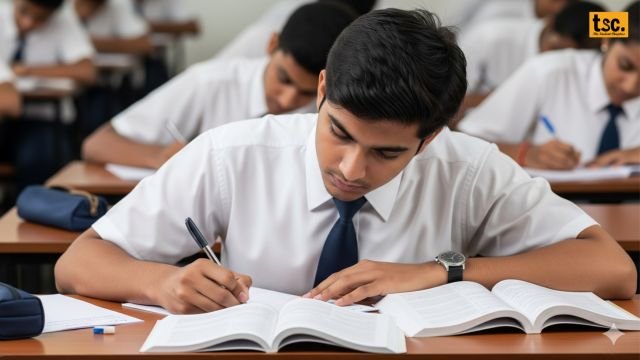
I am pretty much sure you all have already heard about the Open-Book Assessments (OBAs) scheme of the Central Board of Secondary Education (CBSE). People are debating on all social media platforms regarding the Central Board of Secondary Education’s (CBSE) recent introduction of Open-Book Assessments (OBAs). As they are all worried about the future of education in India.
Let me know in the comment section, according to you, will it be a boon or a ban for India? The predominant purpose of CBSE, in view of shifting the pattern, is to shift the focus of students from rote memorisation to critical thinking, problem-solving, and application of concepts. However, many people believe that students will become lethargic as they all start taking the exams lightly.
Read More: IIT-JEE Admission 2025: Seats Allotted Exceed Sanctioned Capacity in Most IITs! Can IITs Handle the Surge? Check How Will IITs Manage Here!
Will this innovative approach truly prepare students for the future? Can OBAs help students develop the skills and competencies? Therefore, OBAs promise to promote deeper learning, information literacy, and analytical thinking. Through this post, let’s break down the whole viewpoint regarding Open-book Assessments of CBSE.
Before proceeding further, let me clarify to you all that this OBA is announced only for Class 9 students starting from the 2026-27 academic session. Behind all the bars, the National Education Policy (NEP) has a broader vision of promoting competency-based education.
What are Open-Book Assessments?
Open-book Assessments allow students to bring their resources and study material, such as textbooks, printed content, or other materials specified by the school, with them during the exam and use them while answering questions. I can understand that many of you are taking this decision negatively, but trust the process; the availability of the material does not make the exam easier for them.
Through this, they can develop critical thinking, problem-solving, and application of concepts in them and impede rote memorisation. Moreover, they will face many challenges and blockages too during open-book assessments, as they lie in knowing what to look for and how to use it. Let me clear this up for you with the help of example.
For instance, in a Science paper, students may have all the formulas in front of them, but the real task is to interpret data, analyse patterns, and apply principles to solve a problem. Now, tell me what thoughts are coming to your head in the comment section.
Cast your eyes on: ICAR Counselling 2025: A Long-Awaited Process
Challenges of Open-Book Assessments:
Here are some challenges and concerns regarding Open-book Assessments. Let’s talk about them below!
- It requires teacher training and support
- It demands a strong conceptual understanding
- It may be unsettling for students and teachers initially
- It requires proper implementation and assessment frameworks
Lessons from CBSE’s Past Experiment
This is not shocking for many because CBSE has had past experiences like this before. This is not for the first time. In 2014, it launched the Open Text-Based Assessment (OTBA) for Classes 9 and 11. By 2017, higher authorities decided to discontinue the policies as they came to the conclusion of not meaningfully develop critical or analytical abilities.
Here is the point to be noted that if they restart their policy, then I can surely say that there will be new strategic approaches this time. However, the new OBA scheme differs in its structure and intent. It comes forward this time with a greater emphasis on integrating the approach into regular exams and aligning it with NEP’s broader vision. The rest of everything depends on future statistical data.
Do not miss out: Is Govt Education Losing Appeal? School Enrolment Drops for Third Year in a Row: Understanding the Trends, Implications, and Why Here!
Benefits of Open-Book Assessments:
Besides above mentioned challenges and concerns, there are benefits too, which are worth considering. Below, I have mentioned all the benefits!
- It reduced exam stress
- It promotes deeper learning and understanding
- It encourages self-learning and independence
- It develops critical thinking and analytical skills
- It prepares students for research-based learning and higher education outcomes
Schools’ Preparation
After the coming of the decision of CBSE, everyone shifted their focus to reframing the study pattern for the students of class 9th, as they already acknowledged the challenges of implementation. Principals of school rescheduling and changing the pattern, as there is a need for teacher training, sample papers, and assessment frameworks to guide students properly.
They are taking immediate action suddenly because they do not want their result will suffer in the near future. However, teacher training demands the types of questions that include analysis and applications. Besides this, some schools have already started preparing their faculty and students for the new assessment method.
Read More: US Tightens Visa Rules for International Students Again: Key Highlights and Implications
Student and Parent Readiness
After the announcement came, some parents are showcasing their concerns over the weakening of the foundation of their wards. They are all worried about the idea of seeing their children become lethargic in their studies. While some parents support the idea, others believe that it will reduce the time devoted to studies and impact intellectual development.
Challenges Ahead
The announcement of re-addressing the open-book assessments for class 9th, only this time, has shaken everyone. In the initial stages, it will be different for both students and teachers. Most of the students have misconceptions as they become lethargic because they have the wrong opinion that the format of exam format will be easy, but it is not!
In reality, it demands even stronger conceptual understanding. Schools will need to ensure that students are trained to locate and apply information under time limits, helping them meet the learning objectives. At last, the rest outcome depends on the future! Maybe or may not be it will give fruitful outcomes.
Check out: NEET PG 2025: Understanding the Result and Counselling Process!
Final Verdict
In conclusion, the introduction of open-book assessments by CBSE is a step towards promoting competency-based education and reducing reliance on rote memorisation. While there are challenges ahead, many educators believe that it could reshape exam culture and promote deeper learning. With proper implementation, teacher training, and student preparation, OBAs could be a game-changer in the Indian education system.


